
Life on the Persian Gulf

My first professional career after graduating from FSU was with a large international engineering & construction company based in Houston, Texas. Before long I was sent to work as a worldwide buyer on several massive construction projects in the Middle East. My offices were based in Al Khobar and Dhahran, Saudi Arabia. I also worked construction at a gasoline refinery in Ras Tanura, a gas-oil separation plant in Khurais, and a drilling camp in the Rub Al Khali desert ("Empty Quarter"), where the daytime temperature hovers around 130 Farenheit in the summer.
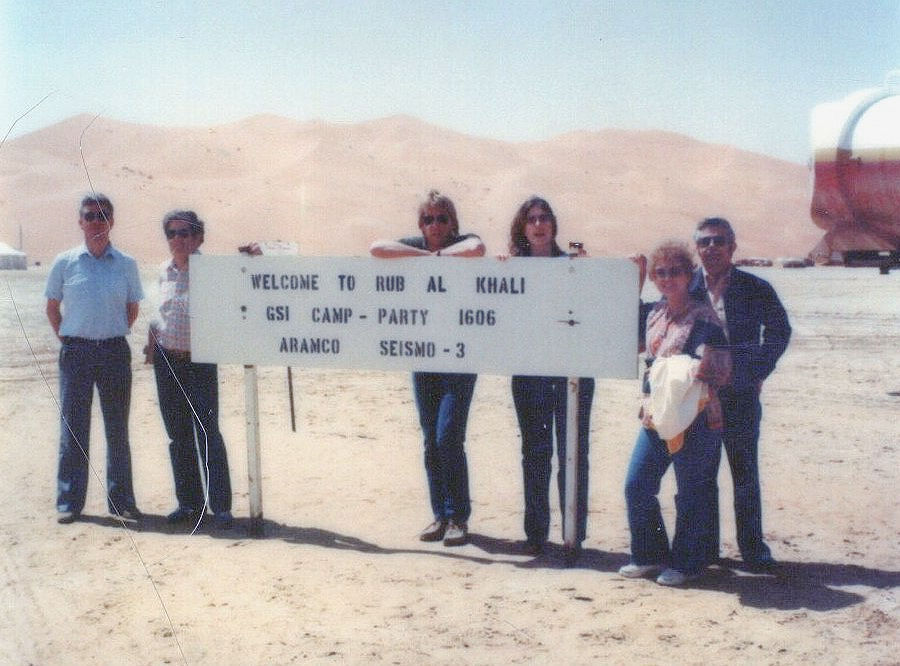
During my years in Arabia in the 1970s and 80s, I was fortunate enough to live and work and play with people from all over the world. With no smart phones or internet, and way before the contemporary modernity of places like Dubai, my fellow expatriates and I created our own good time, smoking hashish hookah in the souks of Dammam, jamming on company-provided instruments and drinking homemade beer in the construction camps at Abqaiq and Ju'aymah... and camping on the white dunes at Half Moon Bay along the Persian Gulf.
Because my work contracts included many weeks of vacation time with plane tickets, I regularly traveled to Europe, the Middle East, Africa, India, the Far East, and Australia. The whole experience seems like a pipe dream when I look back.
The United States was near the peak of its global power during this era, the “greatest nation on earth,” which produced an air of superiority in the American zeitgeist that you could sense from abroad. On one level the USA was globally impressive, simply due to the huge numbers of the high-paying jobs our corporate capitalism produced all over the world, including the oil industry I worked in. As a young man in my twenties trying to get ahead, I wasn’t complaining.
America was also at its peak culturally. Most of the world loved our music, movies, our fashion design, sports, and our progressive political achievements, beginning way back in the jazz age and rolling forward into mid-century.
But I also began to see that certain tribes in America were ignorant of other nations' cultures and values. Those not in line with their particular points of view were often unfairly judged and mistreated. And we all know how many wars US administrations of all stripes have waged, bombing foreign nations, assassinating leaders, and installing dictators in since WWII, based on our selfish objectives.
In other words, we haven't performed much differently than other imperial powers who roamed the planet in prior centuries. To be fair, America has also educated and trained and helped to lift many people in developing nations out of poverty. That was naturally a part of my work when I was there, training young Saudis on the job.
Unfortunately over time, as the leading world hegemon, America began shifting its emphasis from balanced business objectives and serving others to economic greed and political power and control. Still, I remain hopeful that future moves will be made in a more intelligent direction. As Winston Churchill offered, "You can always count on the Americans to do the right thing...after they've tried everything else."
Every human life goes through stages of youth, growth, maturity and passing. The story of a nation should follow the same rhythm, which is competely natural. With luck and insight, America could evolve into a seasoned multi-culture that is done operating as a great economic and political power and now ready to find its place as a rich culture for human self-development, cutting edge research and education in all scientific and humanistic fields. Our national economy would now be driven by local and regional companies whose goal is to serve the community first, the state second, and broader national needs third. This would build a balanced, long-lasting lattice to interact in a mutually beneficial way with other nations.
We need to continue welcoming immigrants from all stripes to our shores, provide for their education, and behave better when we visit them on their shores. In the meantime, if you want a crash course in multi-culture, go live and work abroad yourself.

There were so many nationalities working in Saudi Arabia in the oil construction days—American, European, African, Middle Eastern, Indian, Southeast Asian, Australian, on and on. This multi-cultured setting opened a new set of doors for us all to walk through, exchanging ideas and learning about each other. A lot of problems in the world would automatically be solved if we created more ways for cultures to intermingle person to person, instead of observing each other through social media and streaming news.
Because I was a worldwide buyer with a high signature authority on huge construction projects, spending hundreds of millons of the Saudi Kingdom's petro-dollars, I got to know quite a few wealthy people with companies that were trying to get business from Aramco, the main entity to whom I contracted myself.
I was also a working musican and formed a few bands overseas, playing at diplomatic events and lavish private parties all over the Kingdom. We occasionally opened shows for big name touring acts that came over from the States to perform for the thousands of Americans working there.
Working as an expatriate was one of the most expansive periods in my life, broadening my worldview and opening new chambers in my mind I didn’t even know existed. For more juicy details on my years living and traveling abroad, consult Stumbling to Enlightenment and The Education of Adam Speaker on the BOOKS page.
No matter where you hail from, get out of your homeland and travel abroad as much as you can. If you're a tourist, avoid too many destinations on a single trip. Stay in one place for week or two and hang with the locals. If you're a student, do a year overseas. Create a business or become an artist overseas. It will crack open new ways of thinking about our hugely diverse world, and your place in it.
Though I traveled the world over in the 70's and 80's and have tons of photos from all the destinations, I chose just to present some pics of Saudi Arabia, Kenya, and the Seychelles Islands, a tiny archipelago a thousand miles of the coast of East Africa in the Indian Ocean. All shot on average quality film cameras.


