
Writers Rock

"By the time you’re done reading this book, you'll know what it’s like to possess the classical wisdom of the Oracle of Delphi, the supreme humility ofLao Tzu, the compassion of Jesus, and the non-duality of the Buddha all at once."
Said Dawlabani, author of
Second Sapiens, The Light of Ishtar,
and Memenomics
The Education of Adam Speaker was published academically in 1998 as my masters thesis. Having written a ton of research papers in the course of my graduate study, I didn’t want to write another paper. I wanted to come out of school with a tool I could use. So for my thesis project I wrote a philosophical novel that would cover all the ancient philosophers I had studied, presenting their ideas in an imaginal work of fiction.
I had never written a book before, much less a novel, and yet it just kind of flowed out of me. How did this happen? Well, as a part of my re-education I had become proficient at meditation from training with several sects of Buddhist monks. I then began designing meditations of my own that were more active and creative than basic mindfulness.
I sat in meditation every morning with a legal pad next to me and sort of dreamed the book a chapter at a time, coming out of meditation occasionally to jot down notes. This process would take about an hour and then I would hop on the computer and start banging away at the keys, completing at least part of a chapter. In Jungian terms, I was accessing the Collective Unconcious, which Plato called the Realm of the Forms. Of course it has many names in the East as well, the Unborn Mind, Brahman-Atman, Tao, and so on.
I actually couldn’t believe it when the book was finished in just three months. I had woven together the teachings of nine Perennial Philosophers into what the publishing world calls a “novel of ideas.” But it was more than a novel because I had documented everything with scores of footnotes and an extensive bibliography. The book later became the required text for classes I taught at several community colleges.
* * *
.jpg)
"It’s so refreshing to know that there are a few people out there who understand the synthesis of knowledge and who are willing to look beyond literal interpretations of sacred works. I have heard many of my own thoughts echoed in your words, Richard, and can't thank you enough for saying them."
Brooke D., designer
Exploring the Human Spirit is a collection of essays written for a study group called Mindful Medicine Salons. This group grew spontaneously out of a college course I taught in classical philosophy called Spiritual Self-Knowledge East & West. Students who took this course requested I start a study group to explore more deeply the ideas presented in class.
I obliged and took the approach of writing an essay for each salon on some topic in philosophy, religion, psychology, mythology, and related subjects. I simply picked topics I thought would benefit others, and the whole thing just unfolded spontaneously over a few years. I later edited the essays down into the published book you see now. Of the twenty-one essays, here are some of the titles:
_ Voices, Synchronicity, and Creativity
_ Three Ways to Explore the Unconscious
_ Emotions: Divine Visitors in Disguise
_ Adventures in the Nature of Soul
_ Karma and the Wheel of Conditioned Genesis
_ On the Mystery of Love: Rumi and Kundalini
_ The Power of Sacred Sites
_ The Taoist View of Creativity
_ The Psychology of Creation Stories
_ Spiritual Emergence, Spiritual Emergency
Great thanks go to all the students, first because the entire project and the book it produced was their idea, and secondly because they supported the work for many years by showing up and participating. There were several hundred attendants in the first two years alone! As the group grew, we went on a few retreats together to study and discuss the essays at sacred sites, such as the massive Chaco Canyon ruins in New Mexico.
* * *

“By applying your mythological lens to movies I love to watch, things in my life are now clarifying, giving me the perspective to move forward. Richard, please never underestimate the value of what you’re doing. Many, many thanks!”
Ginny Laurent, poet
The Hero's Journey in Film was the natural next step after The Education of Adam Speaker. I realized a common trait among the great world teachers I had studied...they were all heroes. Each overcame significant obstacles as they ventured into unknown territories of the mind, often at great risk, to make lasting contributions to humanity. Their stories inspire us all to embark on our own quests of discovery.
Motivated to integrate the hero’s journey into my curriculum, I began studying the work of Joseph Campbell, the twentieth-century mythologist who was deeply knowledgeable in world religions, mythologies, and Carl Jung’s depth psychology. Campbell identified the connections between these disciplines and presented them in his 1949 classic, The Hero with a Thousand Faces.
Although Campbell’s thinking and writing were brilliant, it hit me that the hero's journey model might be easier for students to absorb with film as the medium. Over a two year period I began studying Hollywood feature films with stories that portrayed the hero quest stages and their deeper implications. I eventually selected twelve of the films that best demonstrated these ideas, and created a college course called Quest Mythology in Film which I taught at several community colleges in Phoenix and at my Mindful Medicine Center in Scottsdale.
These programs proved popular, attracting hundreds of participants over three years. We watched and discussed each film together, and I wrote interpretive papers on each, incorporating substantial student input. The process was highly collaborative and a significant learning experience for me. I eventually published the twelve papers in this, my third book. A college professor in Sao Paolo, Brazil caught wind of the book and asked if he could translate it into Portuguese. Of course I said yes, and soon my book and class were being taught in South America. Proud of that one!
* * *
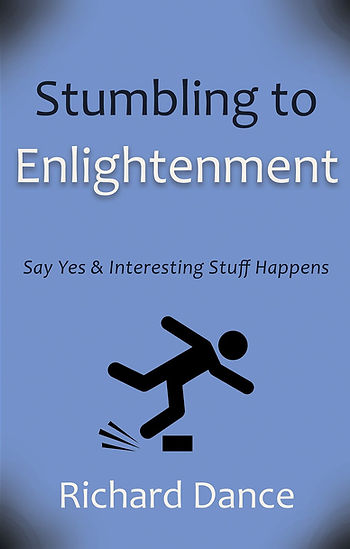
"The author distills complex philosophical ideas into a lucid and engaging narrative, using the lens of his own life story...and what a storied life it is! Richard weaves his rich and far flung experiences into an engrossing and illuminating work."
Rachelle Marmor, MS, MFA
Stumbling to Enlightenment is the result of frequent urging from long-time friends who said I should produce not another book for the classroom, but a personal story because they felt a tale can be more relatable and interesting than a textbook. In that spirit, this memoir takes you on a quick trip through my upbringing and globe-trotting adventures, along with the characters that populated those adventures, and the successes and failures that ensued.
The story then rolls into midlife, when, after a series of personal challenges, I decided to check out for about a decade to study, practice, and teach the wisdom of that colorful band of thinkers known as the Perennial Philosophers, those great world teachers along the Old Silk Road.
Every Perennial Philosopher I have studied urged us all to live life fully, whatever circumstances we are pitched into. Everyone's life is a series of adventures that should be welcomed, even if difficult conditions prevail. To do this, one must develop the training to transcend all pairs of opposites in any life situation. To quote the great Taoist philosopher Chuang Tzu, "When the wise man grasps the pivot, he is in the center of the circle, and there he stands while 'yes' and 'no' pursue each other around the circumference." When we learn the archetypal stages that guide every adventure, we can now proceed with joy and a relaxed smile on our face and let the whole mess roll.
There is no one right way to live a life, but the more you say yes to opportunities that arise, the more interesting things happen. Sometimes you will get your ass in a sling, but the rewards are always grander, or at least more colorful. You fully experience the coincidence of opposites. And with each new adventure, you get better at who you are.
